



If your kid still says “wabbit” instead of “rabbit” and you’ve started quietly Googling at 11 p.m., take a breath. You’re not behind. R is one of the very last sounds kids learn, and a long way behind sounds like F and S.
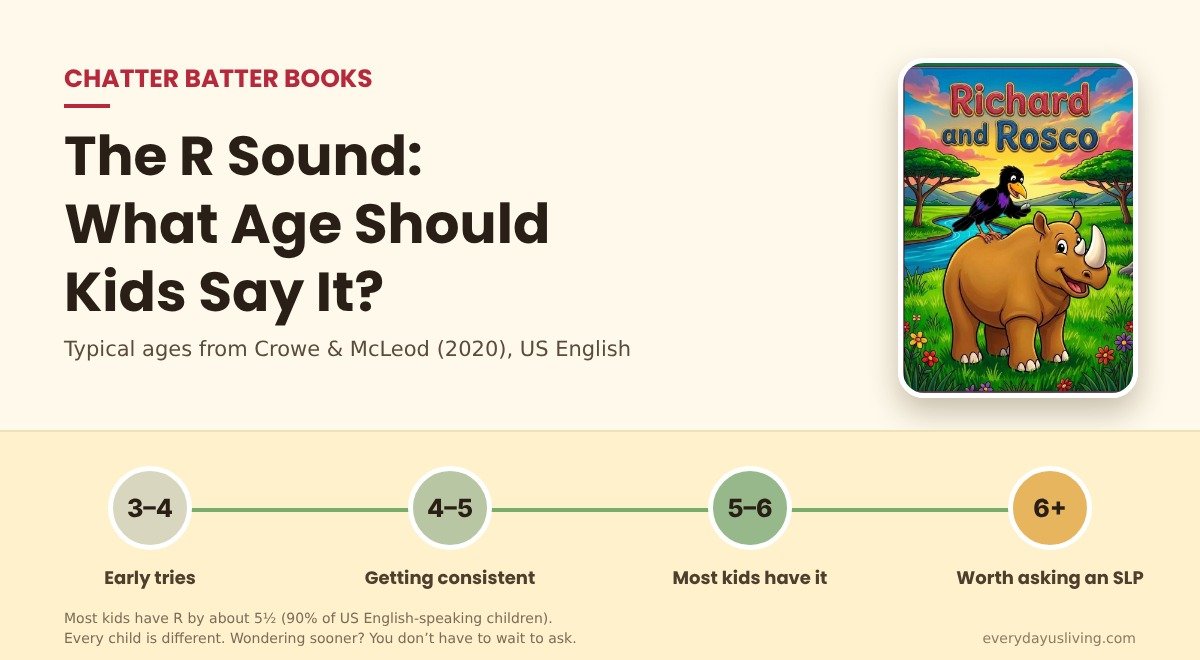
So, what age should kids say the R sound? Most children say a clear R by about age 5½. A 3- or 4-year-old who says “wabbit” is right on track. If R still sounds like W after age 6, or you’re simply wondering, a speech-language pathologist can take a look. You don’t have to wait.
Typical ages for the R sound
These ages come from a review of studies of US English-speaking children. They show when about 90% of children say the sound clearly. Think of them as a guide, not a deadline.
| Age | What’s typical |
|---|---|
| 3–4 | Often says W for R (“wed” for “red”). Very common. |
| 4–5 | R starts showing up in some words and may come and go. |
| 5–6 | Most children (90% by about 5½) say R clearly in most words. |
| 6+ | If R is still being replaced by W, it’s a good time to ask. |
What you might hear
R is tricky because it shows up in different ways: at the start of a word (red), in the middle (carrot), and in the “er, ar, or” sounds (bird, car, door). Many children get some of these before others. While R is developing, you might hear:
- wabbit for rabbit, wed for red
- cawwot for carrot
- “er” words like bird or her that sound a little muffled or vowel-like
When to ask a speech-language pathologist
You don’t have to wait for a certain age to ask. If you’re wondering, ask. A speech-language pathologist (SLP) can tell you whether what you’re hearing is typical and what, if anything, to do next. Good reasons to check in:
- R still sounds like W after age 6
- R is only one of several sounds that are hard to understand
- Family, friends, or teachers often can’t understand your child
- Your child seems frustrated, or avoids talking
- You have any concern about hearing
Your pediatrician can point you to an SLP, and many public schools offer free screenings.
What to do tonight
- Say it back the natural way. If your child says “wabbit,” you say, “Yes! A rabbit!” No "say it again," no quiz.
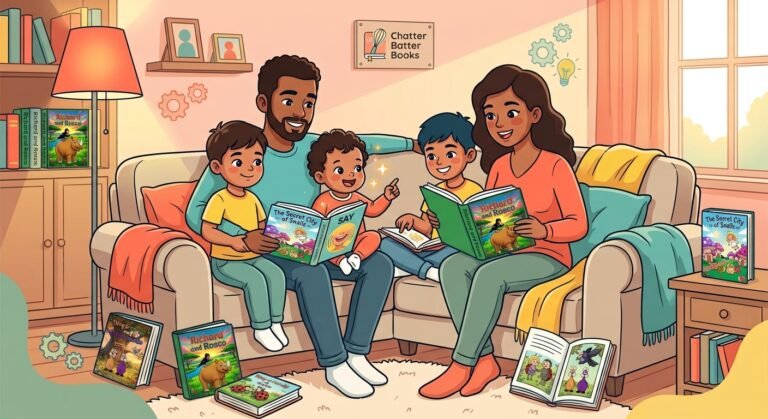
- Read together. A few minutes, a few times a week, with a story that has lots of the sound.
- Make it a conversation. Ask about the pictures, add a little to what your child says, and ask again. ("What’s that?" "A truck." "Yes, a big red truck! Can you spot another one?") My mom put a research sheet on this, called dialogic reading, at the back of the original Chatter Batter books, and it still holds up.
- Keep it warm. A child who feels loved is more willing to keep trying.
The American Academy of Pediatrics recommends shared reading from birth through at least kindergarten, so there’s no wrong time to start.
Get it as an instant digital download and read it together tonight → Richard and Rosco
R was a long road for our son. By the time he started high school it had mostly cleared up. We can’t say what did it. Time, growing up, and reading together all played a part, and I’d never claim it was one thing. What I know is that those nights were never a test. This is exactly why we made Richard and Rosco. Rosco the rhino and Richard the raven are best friends who love running and resting together in every kind of weather. One rainy day they race off to the river, then chase a rainbow hoping for a pot of candy at the end of it, and every few pages the same silly refrain comes back: “Rumble Rumble Rappity Flap, oh my goodness! What was that?” Every R is highlighted right on the page, so the practice happens while you’re just reading together. They never reach the end of the rainbow, and that’s the best part: Richard had fun anyway.
Not sure R is the sound to focus on yet? Take the free 60-Second Sound Check first. It’s not a screening, just a quick way to notice what your child is still growing into.
Frequently asked questions
Is it normal for a 4-year-old to say W instead of R?
Yes. Most 4-year-olds are still learning R, and W for R is one of the most common patterns. About 90% of US children say R clearly by about 5½.
Should I correct my child when they say R wrong?
Usually not directly. Say the word back the natural way (“Yes, a red rabbit!”) and keep going. No quiz, no “say it again.” That keeps talking fun.
When should I ask about R?
If R is still W after age 6, if other sounds are also hard to understand, if your child seems frustrated, or if you have any hearing concerns. Asking earlier is fine too.
Read Next
Should I wait to see if my child outgrows a speech sound?
What Age Should Kids Say the F Sound?
What Age Should Kids Say the S Sound?
What Age Should Kids Say the L Sound?
What Age Should Kids Say the TH Sound?
Working on more than one sound?
Chatter Batter started with my mom, Cindy Judd. She believed a child should feel loved, never tested, so she helped bring stories like these to life with the practice tucked inside. I’m Jed, a dad of seven, and I’ve been remastering these books so more families can read them together. One sound at a time, one story at a time.
This article is for general information, not a substitute for a speech-language evaluation. Every child grows at their own pace. If you’re wondering about your child’s speech or hearing, you don’t have to wait to ask your pediatrician or a speech-language pathologist.
Sources:
Crowe, K., & McLeod, S. (2020). Children’s English Consonant Acquisition in the United States: A Review. American Journal of Speech-Language Pathology, 29(4), 2155–2169. Ages in this article are when 90% of children say the sound clearly; the authors describe them as conservative.
American Speech-Language-Hearing Association. Speech Sound Disorders: Articulation and Phonology. Practice Portal.
American Academy of Pediatrics (2024). Literacy Promotion: An Essential Component of Primary Care Pediatric Practice.
Whitehurst, G. J. Dialogic reading. See the What Works Clearinghouse report.