



What Age Should Kids Say the F Sound? Here’s What 26,000 Kids Told Us
Your toddler says “pish” for “fish” or “dat” for “fat,” and after watching an older sibling wrestle with sounds like R and S for years, you’re bracing yourself for a long wait on this one too.
Good news: you probably won’t be waiting long. So, what age should kids say the F sound correctly? For most kids, right around age 4 — years earlier than sounds like L, S, R, and TH. If your child is younger than that and still swapping F for a P or a B sound, that’s completely normal too.
What the research actually says
F is one of the earlier consonants to fall into place. Research reviewing tens of thousands of children (Sharynne McLeod and Kate Crowe’s cross-linguistic and US-specific reviews) sorts English consonants into rough groups by when most kids master them — an “early eight,” a “middle eight,” and a “later eight.” F sits solidly in the middle group, well ahead of the later group that includes L, S, R, and TH:
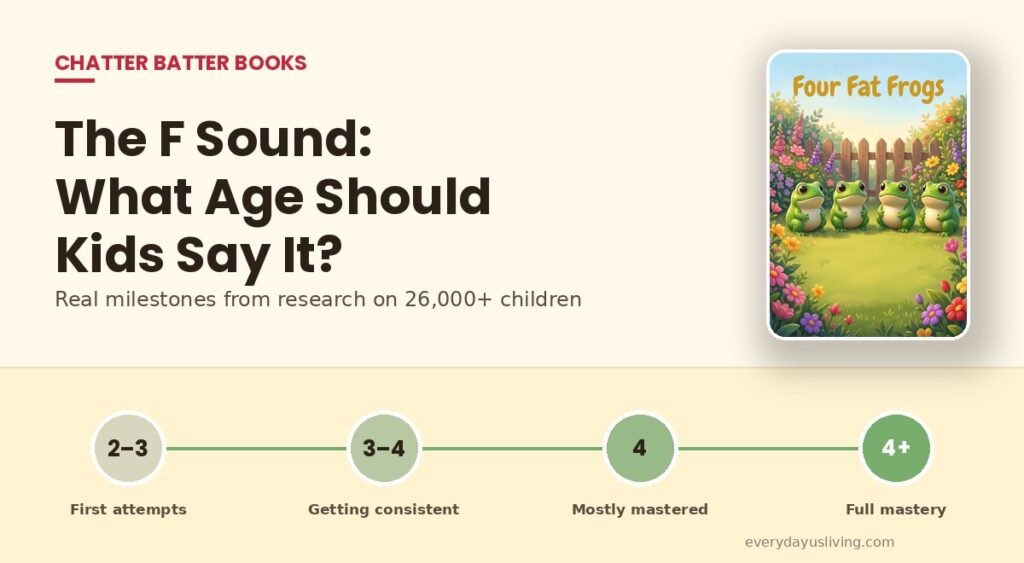
- Ages 2–3: Early attempts at F often come out as a P or B sound (“pish” for “fish,” “bun” for “fun”). Right on schedule for this age.
- Ages 3–4: F becomes noticeably more consistent, especially at the start of words.
- By age 4: This is where research places 90%-of-kids mastery for F — years ahead of L (~5;0), S (~5;6), R (~6;0), and TH (~7;0).
- Age 4 and up: By the time most kids start school, F is a settled, reliable sound.
As always, different studies and charts draw the line in slightly different places, so you might see F’s mastery age listed anywhere from 3;6 to 4;6 depending on the source. Either way, it’s one of the earlier sounds to click into place, not one of the later ones.
When it’s worth a closer look
An occasional P or B swap before age 4 is nothing to worry about. If your child is past 4 or 5 and F is still consistently coming out as another sound, or it’s making them hard to understand, that’s a reasonable time to mention it to your pediatrician or a speech-language pathologist. It isn’t a diagnosis, and it isn’t a race. Every child grows at their own pace.
What to do tonight
Get it as an instant digital download and read it together tonight → Four Fat Frogs
This is exactly why we made Four Fat Frogs — the very first Chatter Batter book, written by my mom, Cindy Judd. It’s a silly, sneaky-smart counting game about four fat frogs (or is it five? the narrator keeps losing count) who live in a flower garden, eat flies and fleas and little aphid bugs, and one day find Fluffy, a runaway rabbit from the farm down the road. The frogs worry about how Fluffy will ever get home — but Fluffy isn’t worried at all. He’s ready to start a home of his own, just like the three little pigs, and he moves right into the flower garden with his new friends. Every F sound is highlighted right on the page, so the practice happens while your child is counting frogs and rooting for Fluffy.
Not sure F is even the sound to focus on yet? Take the free 60-Second Sound Check first — three words for each of five sounds, no test, no diagnosis, just a quick way to notice what your child’s still growing into.
Read Next
Working on more than one sound?
What Age Should Kids Say the S Sound?
What Age Should Kids Say the R Sound?
What Age Should Kids Say the L Sound?
What Age Should Kids Say the TH Sound?
Chatter Batter started with my mom, Cindy Judd. She wrote Four Fat Frogs — and every book in this series — because she believed a child should feel loved, never tested, with the practice tucked inside a story worth reading twice. I’m Jed, a dad of seven, and I’ve been remastering her books so more families can read them together. One sound at a time, one story at a time.
This article is for general information, not a substitute for a speech-language evaluation. If you have concerns about your child’s speech, talk with your pediatrician or a speech-language pathologist.
Sources:
ASHA Practice Portal, Speech Sound Disorders: Articulation and Phonology — Consonant Age of Acquisition.
McLeod, S., & Crowe, K. (2018). Children’s Consonant Acquisition in 27 Languages: A Cross-Linguistic Review. American Journal of Speech-Language Pathology, 27(4), 1546–1571.
Crowe, K., & McLeod, S. (2020). Children’s English Consonant Acquisition in the United States: A Review. American Journal of Speech-Language Pathology, 29(4), 2155–2169.