


What Age Should Kids Say the S Sound? Here’s What 26,000 Kids Told Us
You’re reading a bedtime story and your kid asks for “thomething thweet” instead of “something sweet,” and it’s adorable, right up until the moment you start wondering if it’s supposed to sound like that by now.
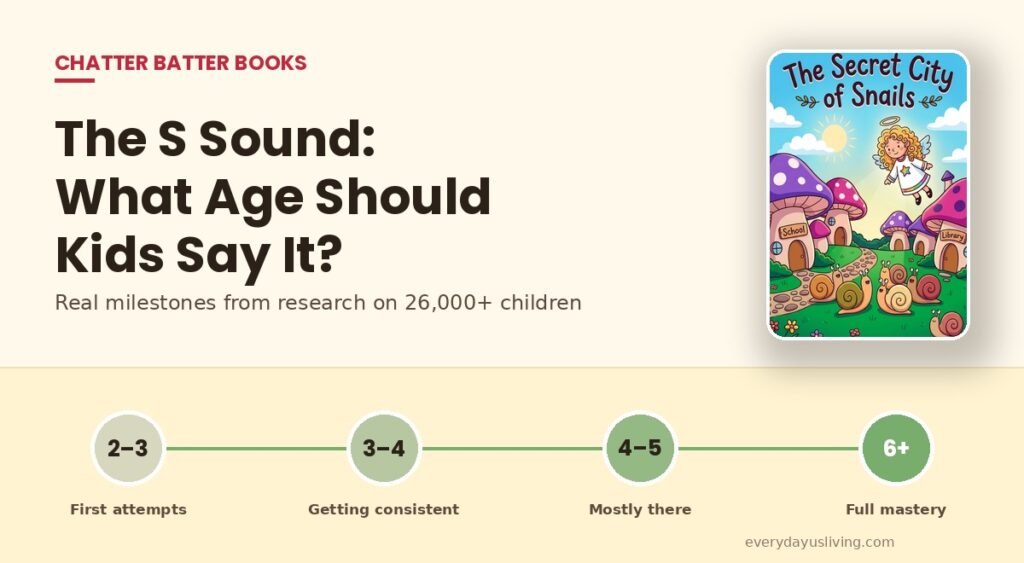
So, what age should kids say the S sound correctly? For most kids, somewhere between 4 and 6 for everyday talking — but a 2, 3, or 4 year old who’s still lisping it, or swapping it for a Th or T sound, is completely on track. S is one of those sounds that takes longer to lock in than people expect, because it needs precise tongue placement most toddlers just haven’t built yet.
What the research actually says
The most solid data we have on this comes from Sharynne McLeod and Kate Crowe’s 2018 review in the American Journal of Speech-Language Pathology, which pooled 64 studies across 27 languages — real data from over 26,000 children, not a guess. A few things stand out from it and from the English-specific charts built on the same research:
- Ages 2–3: First real attempts at S usually show up here, and they usually come out as something else — a T, a D, or that classic “th” swap (“thoup” for soup). Normal, not a sign of anything.
- Ages 3–4: S starts getting consistent in easy words, though it still slips in trickier ones, especially S blends like “st” or “sp.”
- Ages 4–5: This is where most of the research clusters the real turning point. Across the McLeod & Crowe dataset, S was reliably in place for the large majority of kids by around 4–5, using the same 90%-of-kids benchmark researchers use for most sounds.
- Age 6 and up: English-specific development charts put full, no-slip mastery a little later than the cross-language average, generally by 6, sometimes closer to the start of school.
Worth saying plainly: different studies use different cutoffs for what counts as “mastered,” which is exactly why you’ll see S sound charts online that say anywhere from 4 to 7. Nobody’s wrong; they’re measuring different bars. The honest takeaway is the same either way: a preschooler still working on S is doing exactly what preschoolers do.
When it’s worth a closer look
An occasional lisp or a swapped sound before kindergarten isn’t something to worry about; it’s just where your child is right now. If your child is past 6 or 7 and S still consistently comes out as a lisp, or it’s affecting how easily people understand them, that’s a reasonable moment to mention it to your pediatrician or a speech-language pathologist. This isn’t a diagnosis, and it isn’t a race. Every child grows at their own pace.
What to do tonight
Get it as an instant digital download and read it together tonight → The Secret City of Snails
This is exactly why we made The Secret City of Snails. It’s built around a secret phrase, “Simmery Simmery Soda Pop,” that turns the S sound into a game instead of a drill. In the story, Cindy the snail’s angel watches over a hidden city, and every S sound (whether it’s spelled with an s or a soft c) is highlighted right on the page, so the practice happens while you’re just reading together. It ends with a sing-along set to the tune of “Row, Row, Row Your Boat,” which our own kids have sung more times than I can count.
Not sure S is even the sound to focus on yet? Take the free 60-Second Sound Check first — three words for each of five sounds, no test, no diagnosis, just a quick way to notice what your child’s still growing into.
Read Next
Working on more than one sound?
What Age Should Kids Say the L Sound?
What Age Should Kids Say the R Sound?
What Age Should Kids Say the TH Sound?
Chatter Batter started with my mom, Cindy Judd. She believed a child should feel loved, never tested, so she wrote stories with the practice tucked inside. I’m Jed, a dad of seven, and I’ve been remastering her books so more families can read them together. One sound at a time, one story at a time.
This article is for general information, not a substitute for a speech-language evaluation. If you have concerns about your child’s speech, talk with your pediatrician or a speech-language pathologist.
Sources:
ASHA Practice Portal, Speech Sound Disorders: Articulation and Phonology — Consonant Age of Acquisition.
McLeod, S., & Crowe, K. (2018). Children’s Consonant Acquisition in 27 Languages: A Cross-Linguistic Review. American Journal of Speech-Language Pathology, 27(4), 1546–1571.