



What Age Should Kids Say the R Sound Correctly? Here’s What 26,000 Kids Told Us
If your kid still says “wabbit” instead of “rabbit” and you’ve started quietly Googling at 11 p.m., take a breath. You’re not behind. R is, hands down, the sound kids learn last — and by a wide margin.
Here’s what the research actually says, and where the real line is between “totally normal” and “worth a closer look.”
The short answer: R is supposed to take a while
Speech-language pathologists actually have a name for this — they call R, along with sounds like L, sh, ch, and th, the “later eight.” These are the sounds kids are expected to still be fumbling at age four, sometimes five, and it doesn’t mean anything is wrong. ASHA’s own developmental milestones note that even at age four, kids “may make mistakes on sounds that are later to develop — like l, j, r, sh, ch, s, v, z, and th.” That’s not a warning sign. That’s just… childhood.
What the actual numbers look like
The most-cited research on this comes from Sharynne McLeod and Kate Crowe, who pulled data from over 26,000 children across 31 countries. Depending on which version of their analysis you look at, here’s roughly where things land:
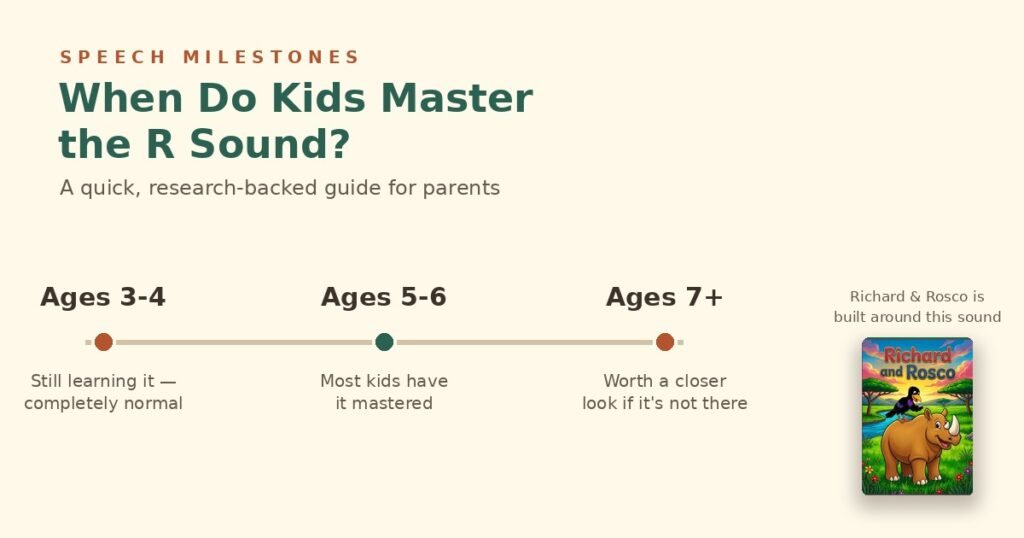
Ages 3–4: Still working on R. Completely normal. Most kids are substituting a W or Y sound instead (“wabbit,” “yabbit,” “wed” for “red”) — this is called gliding, and it’s expected at this age.
Ages 5–6: Most kids have it. McLeod and Crowe’s research puts 90% mastery somewhere in this window — one analysis of U.S. children found the R sound solidifying between 5:0 and 5:11, while a broader chart puts full mastery at 6:0. Either way, by kindergarten or so, most kids have landed it.
Age 7 and up: This is where it’s worth paying attention. ASHA’s guidance is that gliding (the W/Y substitution) should generally resolve by 6–7. If your child is still consistently swapping sounds past age 7, that’s the point to loop in a speech-language pathologist for a real look — not because something’s wrong, but because a professional can tell you whether it’s a developmental lag or something that needs actual practice help.
Ages 8–9 and beyond: Research on treatment timing (Shriberg and colleagues) found that speech patterns really start to solidify by 8 or 9 — meaning the earlier a stuck sound gets addressed after that window, the harder it can be to unlearn. If your child is still not producing R by then, this is the age where you don’t want to keep waiting it out.
One more genuinely useful finding: research by Krueger and Storkel (2022) found that kids as young as 4–5 can succeed with direct R practice just as well as 7–8 year-olds can, if they’re what’s called “stimulable” — basically, if they can already get close to the sound when they try. So “too young to work on it” isn’t really a thing, if your SLP thinks your child is ready.
What you can actually do about it at home tonight
Get it as an instant digital download and read it together tonight → Richard and Rosco eBook
None of this means you need to sit your four-year-old down for drills. Actually — please don’t. The single best thing you can do at this age is exactly what came naturally before all this Googling: read to them. A lot. Sounds that show up over and over in stories your kid actually wants to hear do more for natural sound development than any flashcard ever will.
That’s the whole idea behind Richard & Rosco, one of our free Chatter Batter books — it’s just a story about a rhino and a raven who are friends, except the R sound shows up constantly and naturally throughout it. Your kid isn’t practicing. They’re just hearing “Rosco” and “river” and “rain” fifty times without ever feeling like it’s homework.
If you’re not sure where your child actually stands, we put together a free 60-second Sound Check that walks you through it — no forms to fill out, no appointment to book, just a quick read on whether what you’re hearing is normal-for-now or worth a second look.
👉 Take the free 60-Second Sound Check
And to be clear: none of this replaces an actual speech-language pathologist. If you’re genuinely concerned, or your child is past that 7-ish window and still struggling, a real evaluation is worth it. This is just here to help you tell the difference between “give it time” and “let’s get some help” — without the 11 p.m. spiral.
Read Next
What Age Should Kids Say the L Sound?
What Age Should Kids Say the S Sound?
What Age Should Kids Say the TH Sound?
Sources:
The Best Age to Target the R Sound in Speech Therapy — Rock the R
ASHA — Communication Milestones: 3 to 4 Years
ASHA — Developmental Norms for Speech and Language
McLeod & Crowe (2018) Speech Sound Development Chart — ConductScience