


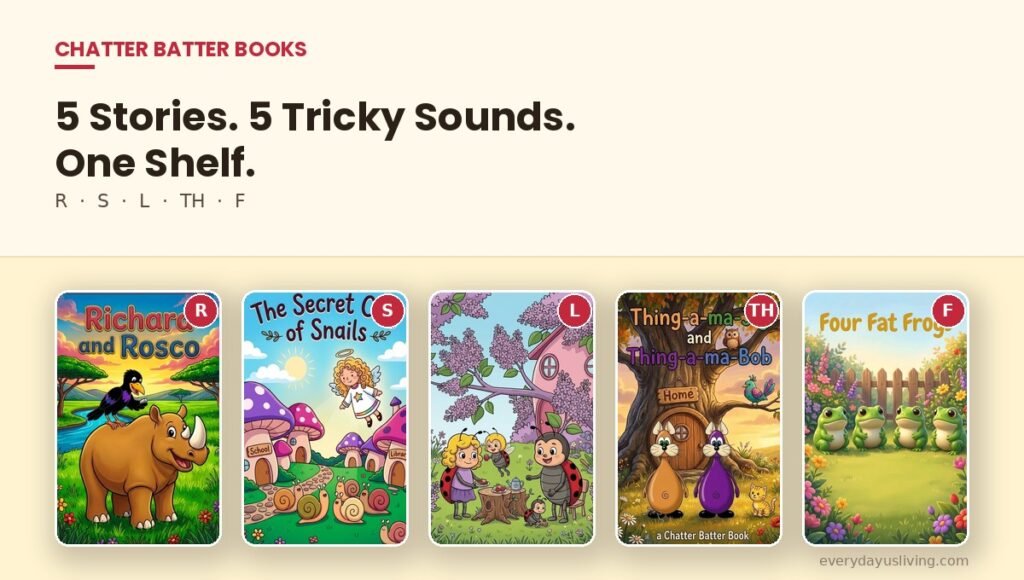
Chatter Batter Books: 5 Stories, 5 Tricky Sounds, One Shelf
If bedtime in your house has quietly turned into speech practice — or you wish it would, without turning into a drill — here’s the whole series in one place.
Chatter Batter Books is a set of five picture books, each one built around a single speech sound kids commonly work on: R, S, L, TH, and F. The idea is simple. Instead of word lists or flashcards, the target sound is woven all the way through a real story — highlighted right on the page — so your child hears it and says it dozens of times without it ever feeling like a lesson. You’re just reading together. The practice rides along for free.
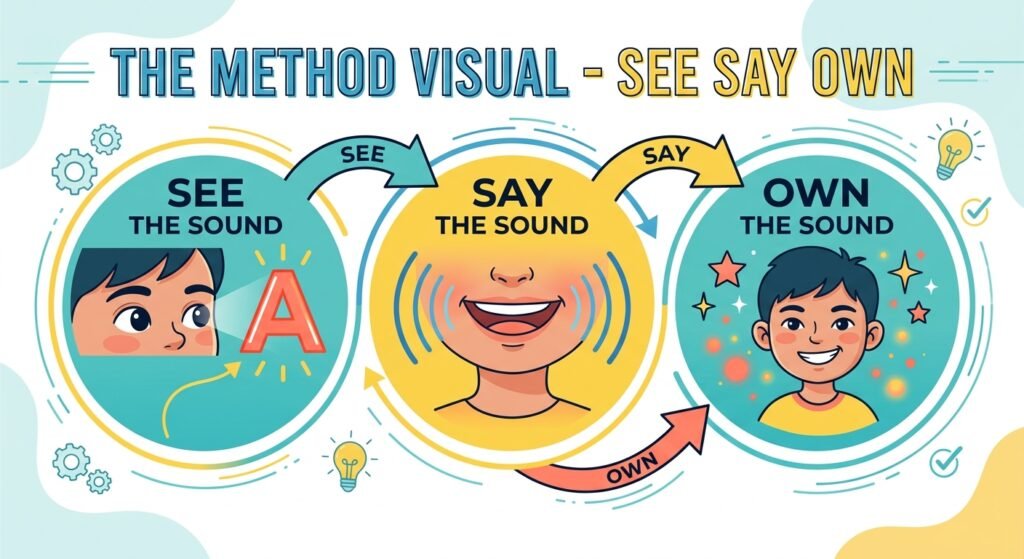
See it. Say it. Own it.
That’s the whole method, and it really is that simple.
See it. The target sound is highlighted right on the page, so your child’s eye catches it before you even get to the word.
Say it. You read it out loud together, the way you’d read any bedtime story. No pausing to correct, no “try that again” — just reading.
Own it. Somewhere around the third or fourth time through, most kids start saying the sound before you finish the sentence. That’s the trick: it’s repetition, just disguised as a story you both actually want to read again.
Not sure which sound your child needs most? The 60-Second Sound Check will point you to the right book in under a minute.
The five books
Richard and Rosco (the R sound) — Two best friends who turn every R into an adventure. R is one of the last sounds most kids fully master, often not until around age 6, so a preschooler still working on it is right on schedule. Read the full R-sound age guide →
The Secret City of Snails (the S sound) — A tiny hidden city where every S sound comes out to play, complete with a secret phrase (“Simmery Simmery Soda Pop”) and a sing-along ending. Most kids have S solidly in place by around 5 and a half. Read the full S-sound age guide →
Laurie the Ladybug (the L sound) — Laurie gets lost in the tall grass and imagines her way home — a longhorn sheep, a brave lion, a singing meadowlark — with a gentle message about courage tucked inside. L tends to arrive earlier than S and R, often settling in by around age 5. Read the full L-sound age guide →
Thing-a-ma-Jig and Thing-a-ma-Bob (the TH sound) — Twin brothers who can cook breakfast and wash dishes just fine, but can’t spell their own names, with school starting this Thursday. TH is the last sound most kids fully lock in — often not until 6 or 7 — so this is the one to be most patient with. Read the full TH-sound age guide →
Four Fat Frogs (the F sound) — The very first Chatter Batter book, written by my mom, Cindy Judd: a silly counting game (four fat frogs, or is it five?) about a runaway rabbit named Fluffy finding a new home. F is one of the earlier sounds to click into place, often mastered by age 4 — so this is usually the one you’ll see progress on first. Read the full F-sound age guide →
Not sure which sound to start with?
Take the free 60-Second Sound Check — three words for each of the five sounds, no test, no diagnosis, just a quick way to notice what your child’s still growing into. Or go straight to the book shelf and pick based on what you’re already hearing at your dinner table.
Every book stands alone at $4.99, or you can grab all five plus the companion Activity Book together for $19.99 — regularly $44.94 bought separately.
Read Next
Working on more than one sound?
What Age Should Kids Say the S Sound?
What Age Should Kids Say the R Sound?
What Age Should Kids Say the L Sound?
What Age Should Kids Say the TH Sound?
Chatter Batter started with my mom, Cindy Judd. She believed a child should feel loved, never tested, so she spent years building stories with the practice tucked quietly inside instead of stacked on top. I’m Jed, a dad of seven, and I’ve been remastering her books so more families can read them the way she intended — together, unhurried, one sound at a time.
These books are a home-practice supplement made for reading together. They aren’t speech therapy and don’t replace a speech-language pathologist. Every child grows at their own pace — if you have concerns about your child’s speech, talk with your pediatrician or a speech-language pathologist.