


Free handwriting practice sheets are easy to find. The right ones are harder. My wife was always searching for a page with the exact words one of our kids needed that week, in the right line size, without handing over an email address first.
We homeschool 5 kids at home, from 2nd grade through a senior finishing Penn Foster. So a one-size worksheet rarely fits anyone. After enough of those searches, we built our own handwriting practice sheets maker. Now we are giving it away. You type the words, pick a line size, and print. There is no sign-up, no ads, and nothing you type leaves your device.

What our free handwriting practice sheets maker does
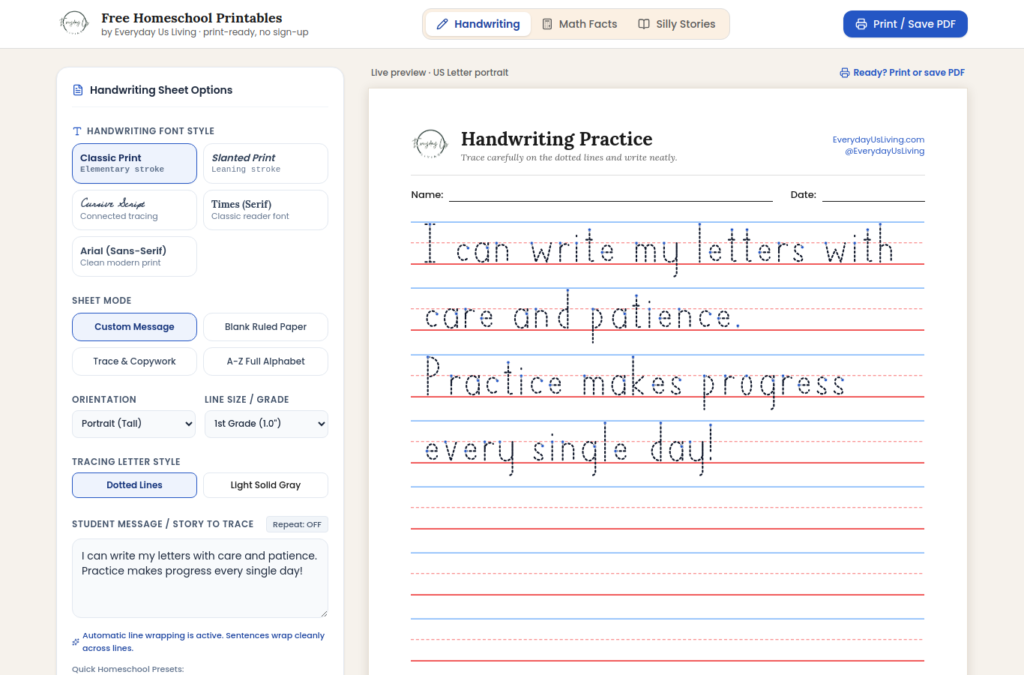
Most printable pages give you the alphabet or one stock sentence. This tool lets you decide what your child traces. Here is what you can make:
- Dotted tracing of any sentence. Names, spelling words, a Bible verse, or a line from your read-aloud. Long text flows onto extra pages instead of getting cut off.
- Five letter styles. Classic Print, Slanted Print, Cursive Script, a Serif style and a Sans-Serif style.
- Single-stroke letters. Every letter is one center line, so a child traces one path, not a hollow outline.
- Four line sizes. Kindergarten, 1st grade, 2nd grade and 3rd grade.
- Four sheet modes. Custom message, blank ruled paper, trace and copy below, and a full A to Z alphabet page.
- Helpful extras. Start dots show where each letter begins, and there is a Name and Date line at the top.
- Your layout. Portrait or landscape on US Letter paper, with dotted lines or light solid gray.
How to make handwriting practice sheets in four steps
- Open the free handwriting sheet maker and stay on the Handwriting tab.
- Type the words or sentence you want your child to trace.
- Pick a letter style, a line size and a sheet mode.
- Click Print / Save PDF. That is it.
The whole thing takes about a minute. As a result, you can make a fresh page each morning instead of hunting for one the night before.
Choosing the right line size for your child
This is the setting that matters most. Unfortunately, it is also the one most free pages get wrong, because they only come in one size. Young hands need big letters. Here is how we think about it:
- Kindergarten size (about 1.25 inches): for ages 4 to 6, or anyone just learning letter shapes. Fewer lines per page, so the page does not feel endless.
- 1st grade size (about 1 inch): the sweet spot for most early writers.
- 2nd and 3rd grade sizes (about 3/4 and 1/2 inch): tighter lines for kids who know the shapes and need neatness and stamina.
If a child is frustrated, go up a size before you look for a different worksheet. In our house, frustration has often been a line that is too small, not a child who is behind. Your experience may be different, and that is okay.
Print, slanted or cursive?
There is no single right answer, and families land in different places. A common path is to get comfortable with print first. Then, once the letters are steady, move to cursive.
Slanted Print is a nice in-between for kids who are curious about cursive but not ready for connected letters. The cursive style here is a simple, connected script made for tracing. In other words, it supports your handwriting curriculum; it does not replace it.
Turn handwriting practice sheets into copy work
The best handwriting practice is doing two jobs at once. For example, type in the Scripture verse your family is memorizing, a sentence from today’s read-aloud, or a short note to a grandparent.
Next, choose the trace-and-copy mode. Your child traces the sentence, then writes it again on the blank line underneath. Five minutes later, it counted as reading, memory work and handwriting. For a big family with lots of grade levels, that kind of overlap is a gift.
Why handwriting still matters
Screens are everywhere, so it is fair to ask whether handwriting is worth the time. Researchers keep finding that it is. According to reporting from NPR on handwriting research, kids who trace and write letters by hand tend to recognize and understand them better than kids who type them.
That does not mean pencils beat keyboards for everything. Still, a few minutes of tracing a day is a small, steady investment that pays off in reading and spelling.
Printing tips so your pages come out right
- Choose US Letter paper and set the scale to 100%, not “fit to page.”
- Set margins to None and turn on Background graphics so the guide lines print.
- To keep a digital copy, choose Save as PDF as the printer.
- Printing a lot? Light gray dotted tracing uses very little ink.
Pair handwriting with speech sound practice
If you are also keeping an eye on your child’s speech sounds, try a simple combo. First, have your child trace words that start with the sound you are working on. Then have them say each word out loud. Our guides on the R sound, the L sound and the S sound include word ideas to get you started.
A note on how we made it
I built this tool with AI help. After that, I did the boring part: I printed every layout and checked that nothing was clipped. It is a free tool from our family, not a curriculum. If something looks off on your printer, please tell me and I will fix it.
Try the free handwriting practice sheets today
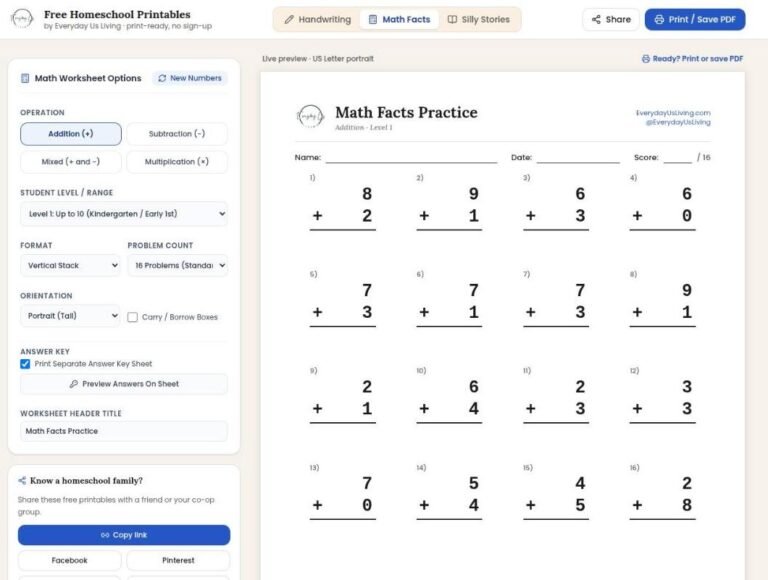
Open the free handwriting practice sheets maker and print your first page. Want more? The same tool also makes math facts worksheets with answer keys and silly fill in the blank stories for kids.
Strong families are built one ordinary day at a time, and sometimes that day includes five quiet minutes at the kitchen table with a pencil. What will your kids trace first? Tell us in the comments. And if you would like more free tools from our family, join our newsletter.