


Your toddler says “pish” for “fish” or “dat” for “fat,” and after watching an older sibling wrestle with sounds like R and S for years, you’re bracing yourself for a long wait on this one too.
Good news: you probably won’t be waiting long. So, what age should kids say the F sound? Most children say a clear F by about age 3, years earlier than sounds like L, S, and R. If your child is 2 and still swapping F for P or B, that’s completely normal. If F still sounds like P or B after age 4, or you’re wondering sooner, a speech-language pathologist can take a look.
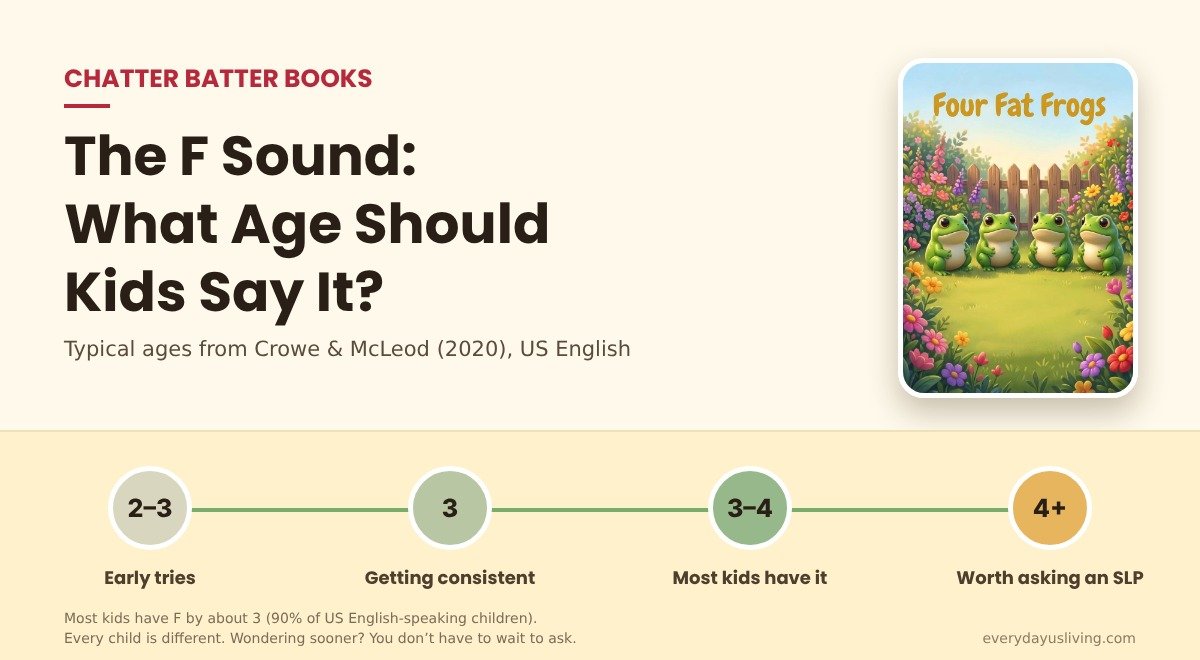
Typical ages for the F sound
These ages come from a review of studies of US English-speaking children. They show when about 90% of children say the sound clearly. Think of them as a guide, not a deadline.
| Age | What’s typical |
|---|---|
| 2–3 | F may sound like P or B (“pish” for “fish”). Very common. |
| 3 | F is becoming more consistent. |
| 3–4 | Most children (90% by about 3) say F clearly in most words. |
| 4+ | If F still sounds like P or B, it’s a good time to ask. |
What you might hear
F is made with your top teeth on your bottom lip, which a child can see you do, and that helps. While F is developing, you might hear:
- pish for fish, bun for fun
- F left off the end of words (lea for leaf)
When to ask a speech-language pathologist
You don’t have to wait for a certain age to ask. If you’re wondering, ask. A speech-language pathologist (SLP) can tell you whether what you’re hearing is typical and what, if anything, to do next. Good reasons to check in:
- F still sounds like P or B after age 4
- F is only one of several sounds that are hard to understand
- Family, friends, or teachers often can’t understand your child
- Your child seems frustrated, or avoids talking
- You have any concern about hearing
Your pediatrician can point you to an SLP, and many public schools offer free screenings.
What to do tonight
- Say it back the natural way. If your child says “pish,” you say, “Yes! A fish!” No "say it again," no quiz.
- Read together. A few minutes, a few times a week, with a story that has lots of the sound.
- Make it a conversation. Ask about the pictures, add a little to what your child says, and ask again. ("What’s that?" "A truck." "Yes, a big red truck! Can you spot another one?") My mom put a research sheet on this, called dialogic reading, at the back of the original Chatter Batter books, and it still holds up.
- Keep it warm. A child who feels loved is more willing to keep trying.
The American Academy of Pediatrics recommends shared reading from birth through at least kindergarten, so there’s no wrong time to start.
Get it as an instant digital download and read it together tonight → Four Fat Frogs
This is exactly why we made Four Fat Frogs, the very first Chatter Batter book, written by my mom, Cindy Judd. It’s a silly, sneaky-smart counting game about four fat frogs (or is it five? the narrator keeps losing count) who live in a flower garden, eat flies and fleas and little aphid bugs, and one day find Fluffy, a runaway rabbit from the farm down the road. The frogs worry about how Fluffy will ever get home, but Fluffy isn’t worried at all. He’s ready to start a home of his own, just like the three little pigs, and he moves right into the flower garden with his new friends. Every F sound is highlighted right on the page, so the practice happens while your child is counting frogs and rooting for Fluffy.
Not sure F is the sound to focus on yet? Take the free 60-Second Sound Check first. It’s not a screening, just a quick way to notice what your child is still growing into.
Frequently asked questions
Is it normal for a 2-year-old not to say F?
Yes. F is typically in place by about 3, but many 2-year-olds are still working on it.
Why does my child say P or B for F?
F takes a little more control than P or B, because the air has to keep flowing instead of stopping. Many children swap them for a while.
When should I ask about F?
If F still sounds like P or B after age 4, if other sounds are also hard to understand, if your child seems frustrated, or if you have hearing concerns. Asking earlier is fine too.
Read Next
Should I wait to see if my child outgrows a speech sound?
What Age Should Kids Say the S Sound?
What Age Should Kids Say the L Sound?
What Age Should Kids Say the R Sound?
What Age Should Kids Say the TH Sound?
Working on more than one sound?
Chatter Batter started with my mom, Cindy Judd. She believed a child should feel loved, never tested, so she helped bring stories like these to life with the practice tucked inside. I’m Jed, a dad of seven, and I’ve been remastering these books so more families can read them together. One sound at a time, one story at a time.
This article is for general information, not a substitute for a speech-language evaluation. Every child grows at their own pace. If you’re wondering about your child’s speech or hearing, you don’t have to wait to ask your pediatrician or a speech-language pathologist.
Sources:
Crowe, K., & McLeod, S. (2020). Children’s English Consonant Acquisition in the United States: A Review. American Journal of Speech-Language Pathology, 29(4), 2155–2169. Ages in this article are when 90% of children say the sound clearly; the authors describe them as conservative.
American Speech-Language-Hearing Association. Speech Sound Disorders: Articulation and Phonology. Practice Portal.
American Academy of Pediatrics (2024). Literacy Promotion: An Essential Component of Primary Care Pediatric Practice.
Whitehurst, G. J. Dialogic reading. See the What Works Clearinghouse report.
A playful way to practice: Our free, ad-free kids’ arcade has a listening game called Sound Safari. Your child hears the “F” sound, then taps the bushes whose words have it. It’s a fun extra for home, not a replacement for speech therapy.