


What Age Should Kids Say the TH Sound? Here’s What 26,000 Kids Told Us
Your kid says “I fink so” instead of “I think so,” or “dat one” instead of “that one,” and part of you wonders whether this is the sound you should start working on — especially if the R, S, and L sounds already seem to be coming along.
So, what age should kids say the TH sound correctly? Later than almost every other sound in the English language — most kids aren’t fully solid on TH until around 6 or 7. If your child is younger than that and still swapping in an F, V, or D sound, that’s not behind. That’s exactly on schedule.

What the research actually says
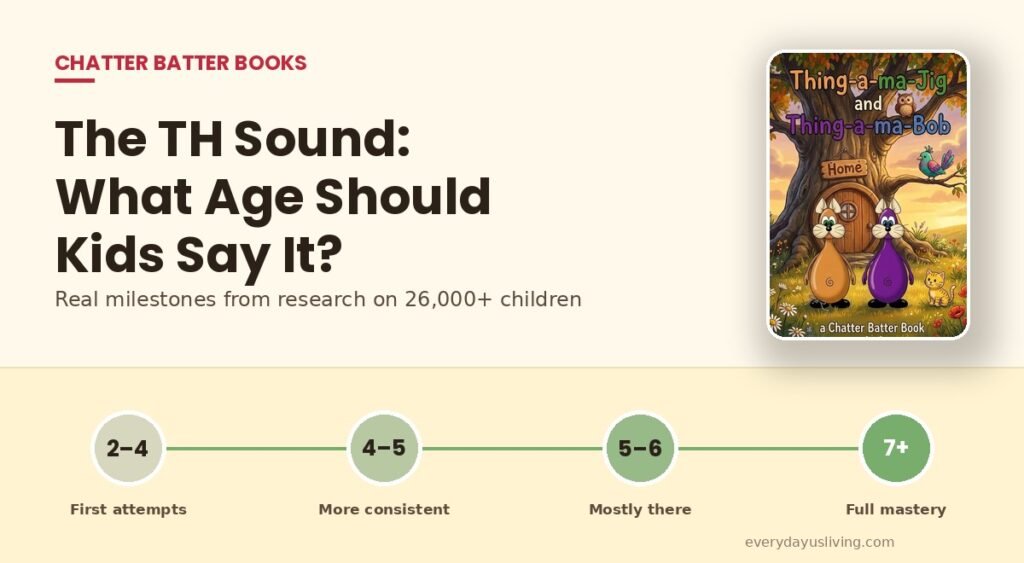
TH is unusual in a couple of ways. First, it’s really two sounds spelled the same way: the “voiceless” TH in words like “think” and “Thursday,” and the “voiced” TH in words like “that” and “brother.” Second, of all the English consonants researchers have studied, TH is the one that takes longest to lock in. Research reviewing tens of thousands of children (from Sharynne McLeod and Kate Crowe’s work, spanning both a 27-language cross-linguistic review and a US-specific English review) places TH dead last in the developmental lineup:
- Ages 2–4: Early attempts at TH usually come out as an F, V, or D sound (“fumb” for “thumb,” “dat” for “that,” “bruvver” for “brother”). Totally normal — TH hasn’t really shown up on the radar developmentally at this age.
- Ages 4–5: TH starts appearing more often, but F/V/D substitutions are still very common and expected.
- Ages 5–6: More kids are getting TH right in easy words, though it’s still shaky in tougher spots or fast speech.
- Around age 7: This is where research places 90%-of-kids mastery for both the voiced and voiceless TH sounds — later than L (around 5), S (around 5;6), and R (around 6). TH is, quite literally, the last sound most kids fully master.
So if your child is 5 and still saying “free” for “three,” that’s not a red flag — that’s a kid who’s exactly where most 5-year-olds are. Even a 6-year-old still working on TH is well within the typical range.
When it’s worth a closer look
An F, V, or D swap for TH is expected well into early elementary school, so there’s no need to jump to conclusions early. If your child is past 7 or 8 and TH is still consistently substituted, or it’s affecting how easily people understand them, that’s a reasonable time to mention it to your pediatrician or a speech-language pathologist. It isn’t a diagnosis, and it isn’t a race. Every child grows at their own pace.
What to do tonight
Get it as an instant digital download and read it together tonight → Thing-a-ma-Jig and Thing-a-ma-Bob,
This is exactly why we made Thing-a-ma-Jig and Thing-a-ma-Bob. It’s the story of twin brothers who hatched from the same egg, who can cook breakfast and wash dishes just fine, but can’t spell their own names — and school starts this Thursday. Thing-a-ma-Jig spends the whole book worried, right up until his brother tells him, “Don’t worry, brother, that’s what school is for. We’ll have a teacher that will teach us to think big thoughts.” He finally settles down to sleep — and immediately discovers a brand new worry (he can’t tie his shoes!) while Thing-a-ma-Bob just keeps snoring beside him. Every “th” in the story is highlighted right on the page, so your child gets the practice while you’re just reading together about two brothers who love each other through every worry.
Not sure TH is even the sound to focus on yet? Take the free 60-Second Sound Check first — three words for each of five sounds, no test, no diagnosis, just a quick way to notice what your child’s still growing into.
Chatter Batter started with my mom, Cindy Judd. She believed a child should feel loved, never tested, so she helped bring stories like this one to life with the practice tucked inside. I’m Jed, a dad of seven, and I’ve been remastering these books so more families can read them together. One sound at a time, one story at a time.
This article is for general information, not a substitute for a speech-language evaluation. If you have concerns about your child’s speech, talk with your pediatrician or a speech-language pathologist.
Read Next
Working on more than one sound?
What Age Should Kids Say the S Sound?
What Age Should Kids Say the R Sound?
What Age Should Kids Say the L Sound?
Sources:
ASHA Practice Portal, Speech Sound Disorders: Articulation and Phonology — Consonant Age of Acquisition.
McLeod, S., & Crowe, K. (2018). Children’s Consonant Acquisition in 27 Languages: A Cross-Linguistic Review. American Journal of Speech-Language Pathology, 27(4), 1546–1571.
Crowe, K., & McLeod, S. (2020). Children’s English Consonant Acquisition in the United States: A Review. American Journal of Speech-Language Pathology, 29(4), 2155–2169.