



What Age Should Kids Say the L Sound? Here’s What 26,000 Kids Told Us
Your kid asks to go outside and play with the “yewwow baww” instead of the “yellow ball,” and it’s the kind of mispronunciation that’s almost too cute to correct — right up until you start wondering whether you should be correcting it at all yet.
So, what age should kids say the L sound correctly? For most kids, somewhere between 4 and 5 for everyday talking — but a 2 or 3 year old who’s still swapping it for a W or Y sound (“wittle” for “little,” “yewwow” for “yellow”) is completely on track. L actually comes in a little earlier than sounds like S and R, but it still takes real time to lock in.

What the research actually says
The best data we have on this traces back to Sharynne McLeod and Kate Crowe’s research reviewing nearly 19,000 to 26,000 children (depending on which of their reviews you’re looking at — cross-linguistic or English-specific) across dozens of studies. L sits in what researchers call the “later eight” consonants, sounds that take longer to master than the earliest ones like P, B, and M, but L is actually the earliest of that later group to arrive:
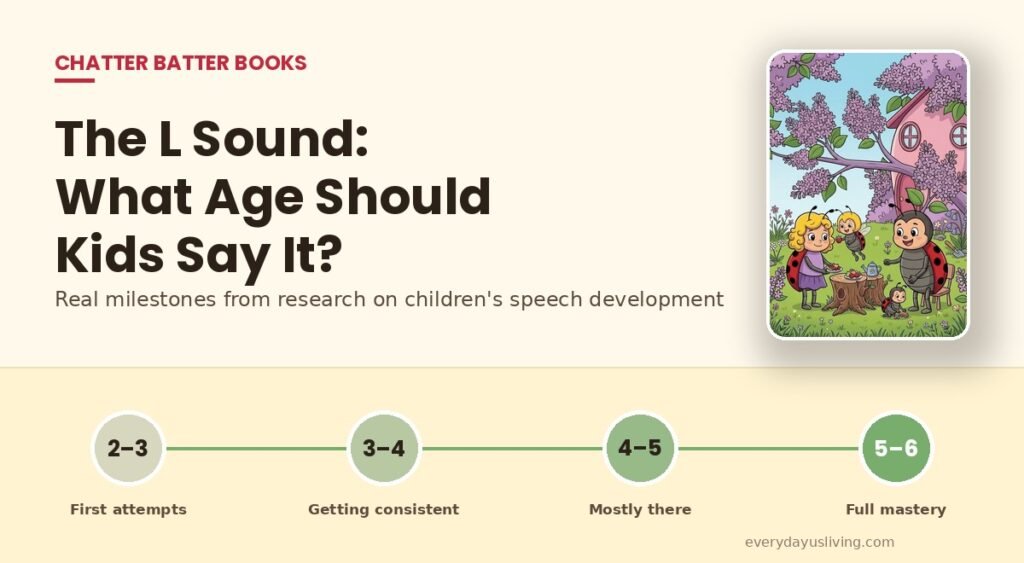
- Ages 2–3: First attempts at L usually show up here, and they usually come out as a W or a Y (“wion” for “lion,” “yaugh” for “laugh”). Completely normal.
- Ages 3–4: L starts getting more consistent in easy words, though it can still slip in tougher spots, especially in blends like “bl” or “fl,” or at the end of a word like “ball.”
- Ages 4–5: This is where most of the research places the real turning point. English-language developmental charts built on the McLeod & Crowe research put 90%-of-kids mastery for L right around age 5, earlier than S (around 5;6) and earlier still than R (around 6).
- Age 5 and up: By kindergarten, the vast majority of kids have L locked in for good.
As always, different studies draw the line in slightly different places depending on what counts as “mastered,” so you’ll see L sound charts online ranging from 4 to 6. The honest version is the same either way: a preschooler still working on L is right on schedule.
When it’s worth a closer look
An occasional W or Y swap before age 5 isn’t something to worry about; it’s just where your child is right now. If your child is past 5 or 6 and L is still consistently coming out as a W or Y, or it’s making them hard to understand, that’s a reasonable moment to mention it to your pediatrician or a speech-language pathologist. This isn’t a diagnosis, and it isn’t a race. Every child grows at their own pace.
What to do tonight
Get it as an instant digital download and read it together tonight → Laurie the Ladybug,
This is exactly why we made Laurie the Ladybug. Laurie gets lost in the tall grass and, instead of staying scared, she imagines her way through it: she becomes a longhorn sheep, then a brave lion, then a meadowlark, singing “LALALA” all the way home. A lizard tells her, “Take courage, little ladybug — just believe in yourself; learn to laugh at your play,” and every L sound in the story is highlighted right on the page, so the practice happens while you’re just reading together and cheering Laurie on.
Not sure L is even the sound to focus on yet? Take the free 60-Second Sound Check first — three words for each of five sounds, no test, no diagnosis, just a quick way to notice what your child’s still growing into.
Read Next
Working on more than one sound?
What Age Should Kids Say the S Sound?
What Age Should Kids Say the R Sound?
What Age Should Kids Say the TH Sound?
Chatter Batter started with my mom, Cindy Judd. She believed a child should feel loved, never tested, so she helped bring stories like this one to life with the practice tucked inside. I’m Jed, a dad of seven, and I’ve been remastering these books so more families can read them together. One sound at a time, one story at a time.
This article is for general information, not a substitute for a speech-language evaluation. If you have concerns about your child’s speech, talk with your pediatrician or a speech-language pathologist.
Sources:
ASHA Practice Portal, Speech Sound Disorders: Articulation and Phonology — Consonant Age of Acquisition.
McLeod, S., & Crowe, K. (2018). Children’s Consonant Acquisition in 27 Languages: A Cross-Linguistic Review. American Journal of Speech-Language Pathology, 27(4), 1546–1571.
Crowe, K., & McLeod, S. (2020). Children’s English Consonant Acquisition in the United States: A Review. American Journal of Speech-Language Pathology, 29(4), 2155–2169.